
The Professional Novel
AI in fiction

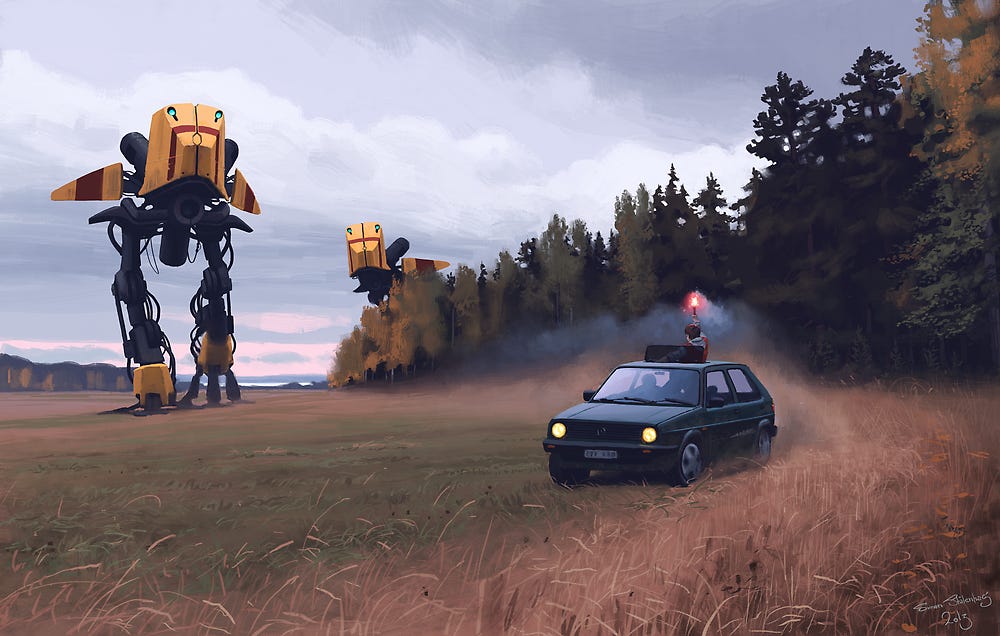
Ray Nayler’s Where the Axe Is Buried (2025) is an almost aggressively professional novel with a few evocative scenes involving autonomous vehicles. One of the scenes involves an automated “forest walker” on two legs, smeared with larch needles and camouflage paint leftover from its service during the “Finnish border war.” The other scene features an old man, operating with melancholy delight a gas-powered car for the first time in years, after a global act of liberating cyberterrorism bricks all AI-driven machines.
I like professional novels, because they all have sci-fi premises and get turned into movies. Who doesn’t like being turned into movies? I too hope to be chucked into the maw of overstimulating garbage. Anyway, when done right, these professional novels, which publishers seem keen to convince me are some sort of triumph on par with a really good op-ed essay (“relevant,” “thought-provoking”), feel like the latter-day inheritors of the pulp tradition. That tends to mean, sadly, not the madcap philosophy found in Philip K. Dick but rather the fierce entertainment of Robert Heinlein’s “juvenile novels,” which are supremely professional exercises in suspense, quick-sketch world-building (light on its feet, never a drag), and rousing drama of transformation.1 Heinlein even stocks those swiftly moving novels with rants. Not that the rants amount to much, in my memory. If great novels constitute essays in drag, then professional novels just have points to make. A professional novel entertains certain ideas while foregoing the more ungainly essayism of the real weirdos.
Maybe this is a problem, that pulp went pro. Nayler’s novel recounts the political changes that convulse both an unnamed Russia-like totalitarian police state (the president of which has his mind transferred from new body to new body to maintain everlasting grip on his surveillance regime) and a set of Western states, including England, that have been given over by popular demand to AI executive power, though they remain parliamentary governments in form. In the totalitarian state, a conspiracy to insert the mind of a wise dissident woman into a presidential body takes menacing and chancy shape. Meanwhile in the AI democracies, a conspiracy undermines by small steps and then all at once the power of the rationalist computers that make political decisions, setting everything from energy prices to legislative agendas.
Nayler doesn’t quite come out and say it, but the nemesis in his novel’s political estimation seems to be the concentration of power in that most of famous of all artificial intelligences, the State itself. What the novel appears to value is therefore the very contentiousness of "opposition”:
There is no cancer like the will, unopposed.
What we need most is opposition. It keeps us not only honest, but human. Without it, any one of us is a monster. Where there is complacency, every human power becomes monstrous. Togetherness is not agreement: it is the collective act of resisting one another.
Sort of inert prose, but the point is clear. The diversity of difference, of differing, ought to be preserved as the most human political value. A high ideal, to be sure.
Elsewhere, one of Nayler’s characters expresses a desire to return to whatever it was that existed before the formation of the totalitarian state and its competitors, the AI democracies (these two are secret counterparts). What existed before was “the eternal flow of argument.” What is this eternal flow of argument to which the world of Where the Axe Is Buried should return? Is it something like what we have in reality today, when the postwar liberal order supposedly breaks down, or is it a sort nostalgically revived Athenian democracy but on an impossibly mass scale? What kind of “eternal flow of argument” preserves, while it does all that eternal flowing, the foundation upon which these arguments takes place? What shared premises make that work? Do we already live in such an eternal flow?
None of this quite rises to the mysterious paradox of William Blake’s “opposition is true friendship,” yet it stirs a heroic sense of human decision. Here there is a fantasy of anti-statist politics, a vision of deliberation beyond the automated processes of state power. For maybe state power always turns into something automatic and mindless. Alas, Nayler’s novel has points but no essays, no stunning (in)sights. It avoids any overwhelming sense of rightist or leftist solutions, offering instead some sort of vaguely liberal, pro-democracy, anarchist spirit, which has an appeal but what and how does it mean?
Repeatedly while reading Where the Axe Is Buried, I thought of William Gibson’s Pattern Recognition (2003), which is also a state-of-the-world’s-soul post-science fiction novel. Gibson strikes me as a less smooth or less natural novelist than Nayler, in terms of managing suspense and narrative momentum and the reaching of satisfying conclusions. What Gibson cultivates instead is a weird observational essayism, a sense of poetry, from his emotional reconstruction of the devastation of 9/11 to his notion of millennial angst as a grief that doesn’t know if it mourns for the 20th or 21st century. Doubtful that I’ll forget Pattern Recognition anytime soon.
The professional novel, like Nayler’s, of course has other pleasures. Where the Axe Is Buried wouldn’t have been enjoyable at all if it didn’t offer the momentum of suspense, the mellow inventiveness of its world, and most importantly to me its moods and textures. The eruptions of strange nostalgia and melancholy yearning made it work, as in the grace notes of its scenes involving driverless cars.
That forest walker mentioned above appears in the lonely taiga, covered in mud and lowering itself to welcome a woman it has been programmed to help. A hatch opens in its side. The woman gets in, and the machine, which can intelligently navigate the terrain until its final muddy stalling, stands up and trudges off with her rattling around inside, wearing an old helmet. There’s something dignified and horse-like about the walker’s fearsome size and enduring dedication. Or maybe switch animals. Remember that brief allusion to a Finnish border war. Here we have an abandoned war machine turned loyal dog in the lonesome northern forests of the world. Cerberus tamed in the quiet wastes, as if before the end of all things there are only gestures of aid. This all has a certain appeal. A forest walker may be waiting for me right now. I can’t help but think that Nayler must have been inspired by the cozy apocalyptic paintings of Simon Stålenhag.
More directly contemporary is a scene with an old man, a driver, who after the destruction of all AI navigation programs, finds himself relishing the control he feels using the wheel, the brakes, the panels of a car. He offers people rides. Though he lives alone by preference, he enjoys this brief contact with others. He talks to them and recalls a time before driving a car was made illegal:
I used to drive just to be behind the wheel. People used to do that, you know. They used to drive for no reason at all. It felt wonderful. As if you could go anywhere. I drove across the whole country once, with a couple of friends. It was the best time of my life. They took that from us—that feeling.
Nice to know that even in the future drivers will ramble on while their passengers sit mutely watching their dying phones.
But really this driver represents a bardic observer. He may be “avoiding the settlements” like Walt Whitman’s solitary thrush, yet he too hymns the world around him and the people in it, including the vehicle which joins him to his fellows and separates him utterly from them. Hence his delight at seeing people dockside, reuniting beside a non-autonomous ship that ferries passengers back and forth across some unidentified stretch of water: “He wondered if people went away simply so they could return.” Not only does this driver hint at the lonely wandering affection and freedom of Whitman but also a famously romantic moment in T.S. Eliot:
We shall not cease from exploration
And the end of all our exploring
Will be to arrive where we started
And know the place for the first time.
How optimistic to imagine a melancholy return to such modest forms of freedom and power! The mythic power of driving. The playful loyalties of machines and their human operators. In an age where we are actively waiting to see what we will do in cars when we no longer drive them, I find it oddly comforting to imagine a melancholic turn at the wheel. One final spell of freedom before the covering dark.
Heinlein’s Starman Jones comes to mind.
The mention of Pattern Recognition made me realize how the sequel Agency presages the present obsession with being "agentic" in response to AI. Score another prophecy for William Gibson.
The plot elements you mention sound fun but looking at the first page of this book it has the same problem I run into with all modern SF, which is that the sentences are so simplistic they repel me. (I suppose that is part of the "professional" aspect you write about.) I miss being able to ignore that and just immerse myself in story. But authors used to be able to do both!
This is great, I particularly liked the reflections on driving. I wonder if you’ve read Jon Fosse’s “Septology,” which features quite a bit of driving and does a very good job showing its appeal.