
Protean redux
It is proper to have done with this solemn mockery

Today, a sequel to my last post, which means more occult secrets of Proteanism, with special guest appearances by two of the great clerks of literature.
So. What Virginia Woolf calls “life” represents a Proteanism, the condition of “infinite variety” for that thousand-feeling creature, the human being, who can say and feel so much, almost anything. What conclusion can be drawn? Well, best to say that the condition of being human is surprise. Surprise at what others come out with, for one. Or, at least, this is Woolf’s vision. Her famous example is Mrs. Brown; I’m only reformulating what I wrote last week before I had to give my loud cat her disgusting dinner.
But despite Mrs. Brown being the exemplar and especially despite “Mrs. Brown” being the name that Woolf uses to designate a woman she saw and overhead on a train, Mrs. Brown is not a living, breathing person. She is instead a character. The mind and the imagination of the woman on the train so impressed Woolf that, as if by compulsion, Woolf imagined the woman back or in return or even in revenge, though also in homage. Woolf adored, one way or another, this woman’s “infinite variety” and so speculated all the more on her life and mind, all because the woman wondered aloud about caterpillars (if we take Woolf at her word). Woolf was impressed, literally, you might say, and thus had her vision of Mrs. Brown. So the novelist subsequently imagines the woman in a variety of settings. She imagines something of the woman’s own disposition and point of view. Mrs. Brown in Woolf’s famous essay appears to be fictional as much as nonfictional, if not more fictional given the profound imaginative resources brought to bear upon “her.” Woolf’s vision of character sits at the intersection of these generic distinctions anyway. When Mr. Ramsay speculates on the evanescence of his life’s work in Woolf’s novel, To the Lighthouse, his reflections simply are an essay. His beautiful and yet also somewhat amused conclusion (“who will blame him if he does homage to the beauty of the world?”) constitutes the real conclusion of a human thought, and well it might, for in “Mr. Ramsay” Woolf reimagined her own father, Leslie Stephen.
For Woolf, a character who feels “real” is not “lifelike.” She doesn’t elaborate on this term beyond dismissing it, but the reason for her dismissal is straightforward. Only dolls aspire to that condition, “lifelike.” Characters that feel real partake instead of Mrs. Brown’s protean capacity to say and think and feel anything from out of their own peculiar imaginative position, which is always and everywhere a position that you or I, meaning anyone who observes or thinks or writes about characters, must imagine for ourselves. The human mind really is imaginary, totally made up, a figure of our endless speculation and reconstruction, as our mind is imagined by others and also by us, ourselves, on our own. You could say, to go even further, that one must commit Ruskin’s pathetic fallacy and thereby project feelings and thoughts onto other human beings simply to live among them, however accurate or inaccurate these projections turn out to be. Philosophically speaking, the novel represents a piece of instrumentation necessary in the history of self-conception, which is to say, the history of projecting consciousness outward and inward. It becomes necessary at times to convince ourselves we have a thousand thoughts and feelings, or could, Likewise for others. The novel as an imaginative exercise appears dedicated to this beautifully unsettling, sometimes even insidious cause.
It is thought, with total justice, that Woolf comes out of and perfects a tradition of the novel that begins with Jane Austen. Consider for a moment an alternative theory: not Austen and not the novel but Charles Lamb and his essays. Which means briefly visiting the South Sea House.
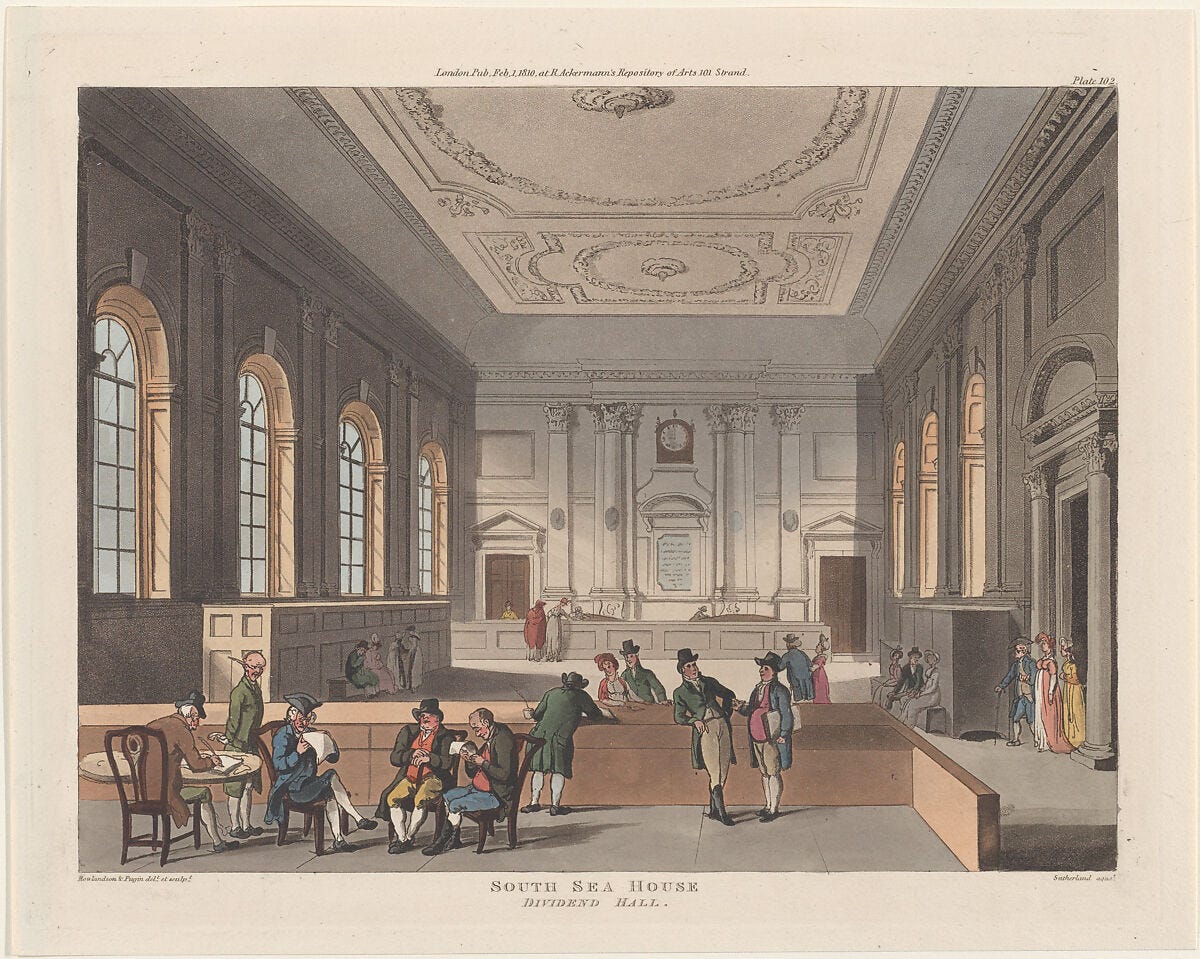
Alongside William Hazlitt, remembered now as a great critic and a liberal contrarian, and Thomas De Quincey, probably the only one among the three of them to write a full-length-ish masterpiece in his Confessions of an Opium Eater, Charles Lamb is the third of the Romantic era’s trio of great English essayists.1 More affectionate and modest, more ironic, idiosyncratic, and nostalgically amused than the others, Lamb wrote his most famous essays under the pseudonym “Elia.” Woolf acclaims Lamb in her essays, but it’s the method in his essay, “The South-Sea House,” that especially draws my attention on the question of character. (Woolf is the one who finally set me on Lamb, appropriately enough given their names).
In “The South-Sea House” (1823), Lamb recalls the former inhabitants of the eponymous building, which had been the bright headquarters of the South Sea Company in better days. Even at the time Lamb first knew the place, in the 1780s and early 1790s, the South Sea House had long ago lost its prosperous reputation, after the collapse of a financial bubble in the 1720s. The South Sea Company never quite recovered. Looking back from the vantage of a century later, Lamb’s essay modestly yet expansively draws several detailed portraits of the men who worked in that busy but sclerotic monument to commerce and banking.
And, in fact, I only want to note one vivid instance of Lamb’s descriptions by comparison with an unexpected way-station on the way to Woolf: Herman Melville. Consider, then, Lamb’s memory, or vision really, of a man he calls Evans:
Melancholy as a gib-cat over his counter all the forenoon, I think I see him, making up his cash (as they call it) with tremulous fingers, as if he feared every one about him was a defaulter; in his hypochondry ready to imagine himself one; haunted, at least, with the idea of the possibility of his becoming one: his tristful visage clearing up a little over his roast neck of veal at Anderton's at two (where his picture still hangs, taken a little before his death by desire of the master of the coffee-house, which he had frequented for the last five-and-twenty years), but not attaining the meridian of its animation till evening brought on the hour of tea and visiting. The simultaneous sound of his well-known rap at the door with the stroke of the clock announcing six, was a topic of never-failing mirth in the families which this dear old bachelor gladdened with his presence. Then was his forte, his glorified hour! How would he chirp, and expand, over a muffin!
Chirping over a muffin! One can begin to imagine the idiosyncratic thoughts and feelings of this man, Evans, and in him see new and greater scenes like those Woolf conjures for “Mrs. Brown.” I emphasized in bold above the phrase “meridian of his animation,” because Lamb’s passage, I’m absolutely convinced, must have been cherished or remembered by Herman Melville. In “Bartleby, the Scrivener,” Melville’s own retrospective narrative of the life of commercial clerks, the writer of Moby-Dick practically paraphrases Lamb’s metaphor and vision in his description of a prickly man in a Wall Street office:
Turkey was a short, pursy Englishman of about my own age, that is, somewhere not far from sixty. In the morning, one might say, his face was of a fine florid hue, but after twelve o’clock, meridian—his dinner hour—it blazed like a grate full of Christmas coals; and continued blazing—but, as it were, with a gradual wane—till 6 o’clock, P.M. or thereabouts, after which I saw no more of the proprietor of the face, which gaining its meridian with the sun, seemed to set with it, to rise, culminate, and decline the following day, with the like regularity and undiminished glory.
Woolf wrote in her consideration of “Mrs. Brown” that characters who are “real” have the power to make you think “of all sorts of things through [their] eyes—of religion, of love, of war, of peace, of family life, of balls in county towns, of sunsets, moonrises, the immortality of the soul.” Lamb’s “Evans” and Melville’s “Turkey” accomplish this same task of vivifying power. No matter that one may be fictional and the other non-. What they are is characters. And a real character renews forever the Proteanist tradition of a thousand feelings and a thousand thoughts, the imaginative yet imaginary human mind.
De Quincey wrote at considerable length about his opium addiction, Lamb wrote more briefly about his alcoholism, while Hazlitt wrote about the compulsions of erotic love. Three compulsions for three essayists.