
Arcana Americana
Malls, prisons, private eyes, and backrooms


The Barnes and Noble at the Mall of America, south of Minneapolis, is a great bookshop. Never mind that it’s 50 yards away from Nickelodeon-branded indoor rollercoasters full of soda-drunk children and half the store is given over to bespoke jigsaw puzzles. The mall maintains an atmosphere that combines the aesthetics of a casino, an airport, and the Super Bowl halftime show. So, of course, I prefer the “real” bookstores in Minneapolis and St. Paul, don’t I? The independent bookstores, yes; I do prefer them, I swear. But it’s simply the case that the MOA B&N (sounds like an acronym for a weapons system) keeps on its shelves a disarmingly tasteful and international selection of books often unavailable at other local shops. I remember finding a copy of Junichiro Tanizaki’s funny and unsettling novella of erotic humiliation, Naomi, at the Barnes and Noble in the Mall of America. Was this a crisis of taste? Their taste or mine? As an anonymous collective of French anarchists once wrote, “Crisis is a means of governing.”1
Every American has weird malls in their blood, like a history of heart disease. We all grew up near some monumental eyesore full of luxury-brand outlets and probably a storefront hawking discount jacuzzis. It’s part of how we became who we are. The malls themselves were dorky and thrilling, kind of like riding a jet ski. Every year when I was a kid, traveling to cardiologist appointments in Philadelphia, we’d pass by the humongous and regionally famous King of Prussia Mall, where, unfortunately, a man once exposed himself to me in a bathroom when I was a teenager. I did not register this at first as a kind of assault. It was only later that I grasped what he had been trying to do. Strange to say, but he was oddly subtle about it. The mall itself otherwise left no mark on my memory, aside from its vastness. What astonishes me now, as an adult, is that there really is a township or whatever in Pennsylvania called “King of Prussia.” The name “King Kong, Pennsylvania” would be, roughly speaking, just as incongruous, but at least that would feel obviously rooted in American culture.
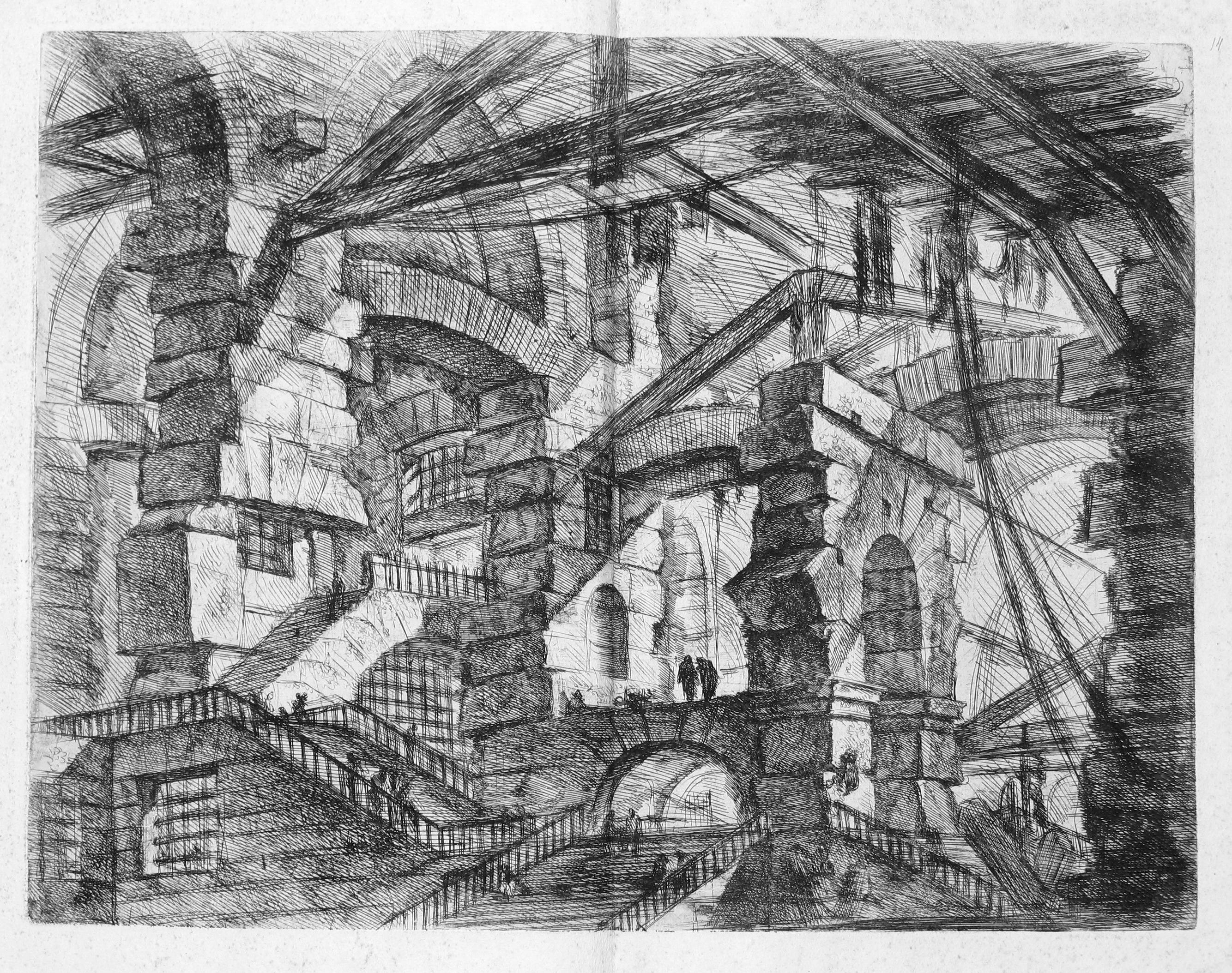
Imagine the history of art exactly as it is now, except the 18th century Italian architect Giovanni Battista Piranesi drew imaginary malls instead of imaginary prisons. Isn’t this the appeal of the memes and YouTube videos that have now become the film Backrooms? This is our culture’s version of Romanticized ruins, the self-haunting prison-maze of “edge cities” (or strip mall suburbia) that seems intended to facilitate commerce and office work yet no one appears able to live there. As in Susanna Clarke’s beautiful novel Piranesi (it’s a novel of endless ocean-filled rooms, full of strange statues and birds), the vast abandoned carpetscapes of Backrooms are the residue of some faded enchantment.
Or, whereas Piranesi is about the place where magic exited the world, Backrooms argues that our bland contemporary spaces are not disenchanted at all. The “backrooms” constitute a growing or gathering enchantment: a menace that is also some sort of thrilling spell, building up power, making copies of us and our hallways, streets, offices, and bedrooms. That these spaces are bland only increases their feeling of vastness. It’s tedious boredom raised to the level of infinite fascination.
-
In all the years I’ve lived in the Midwest, I’ve visited the greatest riverside antique malls mankind has ever known. Far superior to junk shops, these stores are actually archives of amazing and amazingly well-preserved knickknacks, everything from vintage 20th century beer advertisements priced in the thousands to, as the tag in the glass case says, Han dynasty chopsticks priced at a suspiciously affordable 35 bucks. That can’t be right. And the proprietors of the antique malls have stocked their shelves with strange books, including remaindered biographies of disgraced doctors I’ve never heard of and television gourmet chefs later convicted of sex crimes.
At an antique mall in Stillwater, Minnesota a couple weeks ago, I bought a copy of a detective novel called The Doorbell Rang, originally published in 1965. Written by Rex Stout and featuring Stout’s famous detective Nero Wolfe and Wolfe’s assistant, Archie Goodwin, The Doorbell Rang has a decent sense of humor and it’s too short for this to really matter, but it’s not a good novel. Nero Wolfe and Archie Goodwin take on the FBI. They aim to discombobulate the law-enforcement agency’s notorious surveillance apparatus, which is all the brainchild of J. Edgar Hoover. Hoover himself rings the doorbell of Nero Wolfe’s home at the end of the book, though he never appears on the page. Presumably, he wants to meet the genius who foiled him. Cheeky!
While the novel was only a little entertaining, Stout writes about domestic surveillance with vivid paranoia. Certain passages in the book could almost be out of Don DeLillo, with their vision of endless electronic data-gathering. When he considers the “electronic abominations” that might be bugging their home, Goodwin speculates that people in the future “will have to talk with their hands.” Wolfe, who hates all “treacherous machines,” even cars, later comments:
“I have decided,” he said, “that every man alive today is half idiot and half hero. Only heroes could survive in the maelstrom, and only idiots would want to.”
Strange to think of all this from Rex Stout in 1965. The man was only four years younger than Virginia Woolf would have been, had she lived. In fact, Stout was born in 1886, the same year as Junichiro Tanizaki, the famous star of the MOA B&N. At the same time, the famous scene in Mrs. Dalloway where all the pedestrians on a London street turn to watch with fascination the prime minister’s passing car suggests the same gravitational pull that Stout attributes to Hoover. Hoover did, after all, run a sort of secret kingdom in the United States for nearly 50 years. Figures like Hoover and Woolf’s prime minister make the matrix glitch.
Unlike Stout, DeLillo does not shrink from putting J. Edgar Hoover on the page.2 Hoover appears as a character in the long preface to Underworld, hanging out at a baseball game with Frank Sinatra, Jackie Gleason, and the restaurateur Toots Shor. Ulcerous, full of anxiety about the nuclear bomb, and basically offended by the banter of his famous friends, Hoover nevertheless wants to hang out with them. He savors their confidence. As DeLillo writes,
Fame and secrecy are the high and low ends of the same fascination, the static crackle of some libidinous thing in the world, and Edgar responds to people who have access to this energy. He wants to be their dearly devoted friend provided their hidden lives are in his private files, all the rumors collected and indexed, the shadow facts made real.
This is the ultimate shopping experience, a tasteful selection of the best-kept backroom secrets. I’d like to think that Hoover wanted to appear in Stout’s novel The Doorbell Rang and this is why he rang the bell on the last page, except he was too late and the novel ended. Now here he is, he made it onto the pages of Underworld and right at the beginning. The maze stretches out before him, an endless code of American acronyms: FBI ICB KOP MOA B&N. Forget Mall Santa, he’s Mall Minotaur.
Politics aside, is The Coming Insurrection one of the great novellas of the 21st century?
Then again, Hoover was powerful and alive when Stout wrote him into his novel. DeLillo enjoyed the benefit that the dead Hoover would never retaliate against him.
great essay. I am also a big fan of the MOA B&N despite my sense I should be buying my books elsewhere
Hoover is one of the great American villains and there ought to be more novels in which he pops up. He has a significant role in my own forthcoming novel.